Imbalanced Data
The example uses the numeric columns of the adult census dataset, where the task is to predict whether someone earns more than 50K a year. To make the problem hard, we cut the positives down to 400 with imblearn.datasets.make_imbalance, so only about 1% of rows are positive.
xs, y = fetch_openml(data_id=1590, as_frame=True, return_X_y=True, parser="auto")
xs = xs.select_dtypes(include="number")
y = y.cat.codes
xs, y = make_imbalance(xs, y, sampling_strategy={1: 400}, random_state=1)
xs_train, xs_test, y_train, y_test = train_test_split(xs, y, stratify=y, random_state=0)
The test set has 9,289 negatives and 100 positives.
Baseline
A default random forest scores 99% accuracy, which means almost nothing: predicting "no" for everyone would score 98.9%. It finds 15 of the 100 positives.
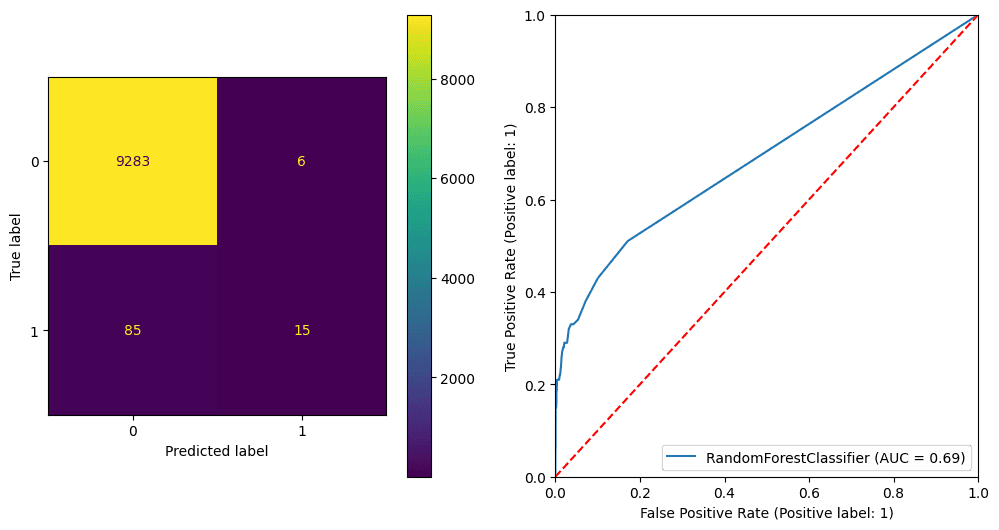
This is where accuracy misleads and precision, recall and the precision-recall curve earn their keep (see Classification Metrics).
SMOTE
SMOTE (Synthetic Minority Over-sampling Technique) generates new minority-class rows by interpolating between existing ones, rather than duplicating them:
- For each minority sample, find its
knearest neighbours within the minority class (k_neighbors, default 5). - Pick one of them at random.
- Create a synthetic sample at a random point on the line between the two:
synthetic = original + (neighbour - original) * random.uniform(0, 1) - Repeat until the minority class reaches the size you asked for (
sampling_strategy; by default, the size of the majority class).
The idea is to give the classifier a fuller picture of the minority region than copies would, though it can also blur the class boundary and create unrealistic rows. Variants:
- Borderline-SMOTE only oversamples minority points near the boundary, those with many majority-class neighbours.
- SVM-SMOTE fits an SVM and generates samples near its support vectors.
- K-Means SMOTE clusters the whole dataset with k-means, then applies SMOTE inside the clusters with a high share of minority points, so synthetic rows land in dense minority regions.
Apply SMOTE only to the training data. Resampling before the train-test split leaks synthetic copies of test rows into training and inflates the scores.
X_train_resampled, y_train_resampled = SMOTE(random_state=42).fit_resample(xs_train, y_train)Class weights
Instead of changing the data, we can make mistakes on the minority class cost more during training. RandomForestClassifier has a class_weight parameter:
None(default): all classes weigh the same."balanced": each class is weighted byn_samples / (n_classes * np.bincount(y)), so rarer classes weigh more."balanced_subsample": the same, but computed on each tree's bootstrap sample.
Results
At a 0.5 threshold, on the 100 test positives:
| Method | ROC AUC | Precision | Recall |
|---|---|---|---|
| Baseline | 0.69 | 0.71 | 0.15 |
| SMOTE | 0.74 | 0.05 | 0.22 |
| Borderline-SMOTE | 0.74 | 0.16 | 0.14 |
class_weight="balanced" | 0.70 | 0.67 | 0.12 |
class_weight="balanced_subsample" | 0.71 | 0.65 | 0.13 |
Nothing helps much. SMOTE improves the ranking (AUC) slightly but, at the default threshold, buys a little recall with a collapse in precision. Class weights barely move a random forest, whose fully grown trees fit the minority points anyway. With a dataset this imbalanced, choosing the threshold deliberately matters as much as the resampling.
Linked from
Revision log
- Migrated from data-science-notes; corrected the SMOTE variants
Tags: Machine Learning